Buying guide · Design & specification
How to Specify Commercial Nightstands for Hotel Guestrooms
A practical framework for dimensions, power, storage, clearances, maintenance, and coordination.
In this guide
This guide provides a procurement framework, not a substitute for project engineering, code review, contractual terms, or product-specific documentation.
Start with the room plan
Confirm the bed size, headboard width, accessible routes, door swings, curtain clearances, and housekeeping access before selecting a nightstand width. A product that works in isolation can fail when it competes with the bed, drapery, outlets, or an adjacent connecting door.
Separate guest use from service access
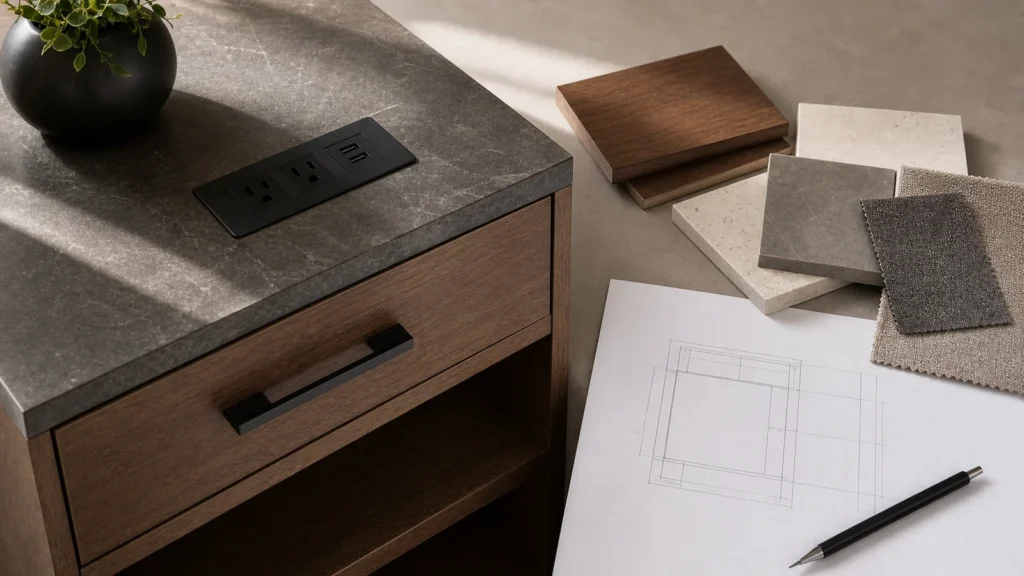
Guest charging should be obvious and comfortable to reach. Serviceable components should be removable without dismantling the complete casegood. Ask where the power module is mounted, how cables are routed, and what must be moved when a component needs replacement.
Define storage deliberately
A drawer, cubby, shelf, or safe compartment serves a different operational need. Use only the storage that supports the room program, then confirm that handles, drawer travel, and equipment ventilation remain physically workable.
Coordinate finishes and edges
Specify the visible finish, edge treatment, interior color, hardware color, and material transitions. Request a finish sample and a model-room review before production. Do not treat a digital rendering as approval of an exact production finish.
Put the requirements in the RFQ
Include quantity, room count, target dimensions, power expectations, finish direction, drawings, packaging needs, target delivery window, and any brand standards. Ask the supplier to identify exceptions and information still needed for engineering review.
Smart Hotel Nightstands: Power, Safety, Maintenance, and Replacement
What procurement and design teams should review when integrating power into bedside furniture.
Treat power as a serviceable component
Power modules age differently from cabinet structures. Define how a failed unit can be removed, disconnected, identified, and replaced without damaging the complete nightstand.
Coordinate with the electrical plan
Confirm outlet locations, cable routing, cord length, wall conditions, and the intended connection method with the project electrical team. Furniture drawings should not substitute for electrical design or code review.
Avoid unverified performance claims
Request the exact module model, supplier documentation, and applicable test or certification files before making a compliance claim. A concept rendering can show placement but cannot prove safety or certification.
Plan guest access and housekeeping
Locate charging points where guests can reach them without pulling furniture away from the wall. Keep cables away from drawer paths, sharp edges, liquids, and housekeeping impact zones.
Include replacements in the procurement discussion
Ask how replacement modules are identified, packaged, stocked, and matched to the approved opening. Record the final module specification with the room package documentation.
Related pages
Planning an order?
Send your product list, quantities and target date. We reply on WhatsApp or by email.
Related guides
Design & specification
Open vs Closed Hotel Wardrobes: A Guestroom Storage Guide
Compare open, hinged-door, sliding-door, and hybrid hotel wardrobes. Plan useful storage, guest access, door movement, and housekeeping around the room.
Design & specification
Hotel Minibar Cabinet Design: Plan a Better Coffee Station
Plan a hotel minibar cabinet and coffee station around appliance fit, guest use, ventilation, cleaning, and service access before finalizing the furniture.
Design & specification
Hotel Luggage Bench Design: A Practical Guestroom Guide
Plan a hotel luggage bench around suitcase use, room circulation, storage, cleaning, surface choice and model-room testing before production.